
IN THIS POST
Our inherent stress response, referred to as fight-or-flight, historically helped humans deal with immediate threats.
In modern times, this response can often do more harm than good.
Understanding the impact of the fight-or-flight response on our mind and body allows us to mitigate many of its negative effects.
You might already be familiar with the fight-or-flight response, a term that describes the instinctive reaction to danger that humans and many other animals have. However, you might not fully understand how this inherent response can become harmful when it’s triggered too often.
In this post, we will elaborate on how the fight-or-flight response is a built-in mechanism that helps us deal with immediate dangers but is not ideally suited to handle the ongoing stressors we face in our current lifestyle.

What is the fight-or-flight response?
The fight-or-flight response is a “reaction to an immediate survival threat, signified by physiological changes, including nervous and endocrine alterations, that equip a human or an animal to react or to retreat” (Britannica, 2019). In simple terms, it’s how our bodies respond when faced with danger.
In the context of our historical development, having a fight-or-flight response makes sense. Early humans, who lived closer to nature, were more likely to face threats from predators.
Our fight-or-flight response is a natural mechanism for dealing with these types of dangers: If a lion attacks, you want your breathing and heart rate to quicken, ensuring your limbs receive more oxygen and can fight or run as swiftly and effectively as possible.
How is fight or flight experienced in the modern world?
Many of the threats we perceive today are not physical but cognitive—we stress and worry over numerous matters that don’t necessitate a physical escape or combat. Nonetheless, our bodies continue to respond to stress in this highly physical manner, leading to elevated sympathetic nervous system activity and a host of anxiety symptoms.
For instance, if you’re preparing to deliver a speech before an audience, you may feel anxious. Your heart rate and breathing are likely to increase, and your appetite may decrease (as your digestive system slows down). Your body prepares to fight or flee if needed—even though it’s not actually applicable in this situation.

6 methods to calm down your fight-or-flight response
Here are some strategies to help calm yourself during stressful times.
Practice deep breathing.
Counteracting the fight-or-flight response often involves deliberately doing the opposite of what your sympathetic nervous system naturally initiates. For instance, when we’re under stress, the part of our nervous system that accelerates our breathing tends to make us breathe more quickly and with shallower breaths. Nevertheless, studies have found that taking slow, deep breaths from our abdomen can effectively help ease the fight-or-flight response.
Recognize your patterns.
Observing when your fight-or-flight response is more active can be helpful. For example, you may find that you’re more likely to feel jittery if you’ve had too much coffee. Identifying this pattern can help you modify your behaviors to calm your stress response.
Embrace acceptance.
Worrying about your fight-or-flight response while it’s happening might intensify or prolong the response by signaling to your brain that you’re in danger. Panic attacks, where fear of the attack itself prolongs its duration, are a prime example. Accepting the sensations of the fight-or-flight response as normal can significantly help in reducing them.
Exercise.
Studies have discovered a correlation between exercise and decreased anxiety. While the reasons for this relationship are still being investigated, one hypothesis suggests that the mild stress induced by exercise enhances resilience to stress more broadly. Other theories suggest that exercise helps in reducing hyperactivity of the sympathetic nervous system (Curtis &O’Keefe, 2002).
Employ cognitive-behavioral strategies.
Recognizing when your fight-or-flight response is activated and reflecting on its usefulness could help decrease this reaction when it’s not beneficial. For instance, if you notice yourself getting overly anxious before a date and contemplating cancellation, acknowledge this fight-or-flight response—are you attempting to “escape” a perceived “threat”?

In reality, you’re not in physical danger, even though your body is preparing for it. Recasting how you view the situation and your physical responses can help calm the sympathetic nervous system.
Consult a professional.
Besides possible mental health issues that a professional could assist you with, medical conditions could also cause an heightened fight-or-flight response. For example, heart arrhythmia can induce a sense of panic. Additionally, asthma medication can stimulate the HPA axis and provoke panic.
MANAGING STRESS RESPONSE FOR ENHANCED MENTAL AND PHYSICAL WELLNESS
The fight-or-flight response is a natural mechanism ingrained within us, designed to protect us from potential threats. Despite the clear advantages of having such a response, many of us struggle with an overactive stress response, contributing to mental and physical health issues. By understanding this response and learning how to manage it, you can strive towards improved mental and physical wellness.

WELCOME FRIENDS!
Hi, I’m Samatha.
I believe every woman deserves to feel steady, strong, and rooted in truth—even when life feels uncertain or overwhelming.
I don’t have all the answers, but I’ve learned to lean on God’s Word, reset my thoughts, and take each day one faithful step at a time.
🌿 If your soul feels tired, you’re not alone. Let’s reset together—with grace, Scripture, and simple rhythms that bring peace.
Start with my free 7-Day Reset with God—one prayer, one verse, one habit at a time.
What Are You Needing Today?
EARNINGS DISCLAIMER
Please be aware that some of the links on this site are affiliate links, and at no additional cost to you, I may earn a commission. This means I may earn a small percentage from any purchases you make through these links, regardless of the platform. However, this doesn't influence my recommendations. For more detailed information, please read my full affiliate disclosure here.
Download you free 7 day reset with god guide
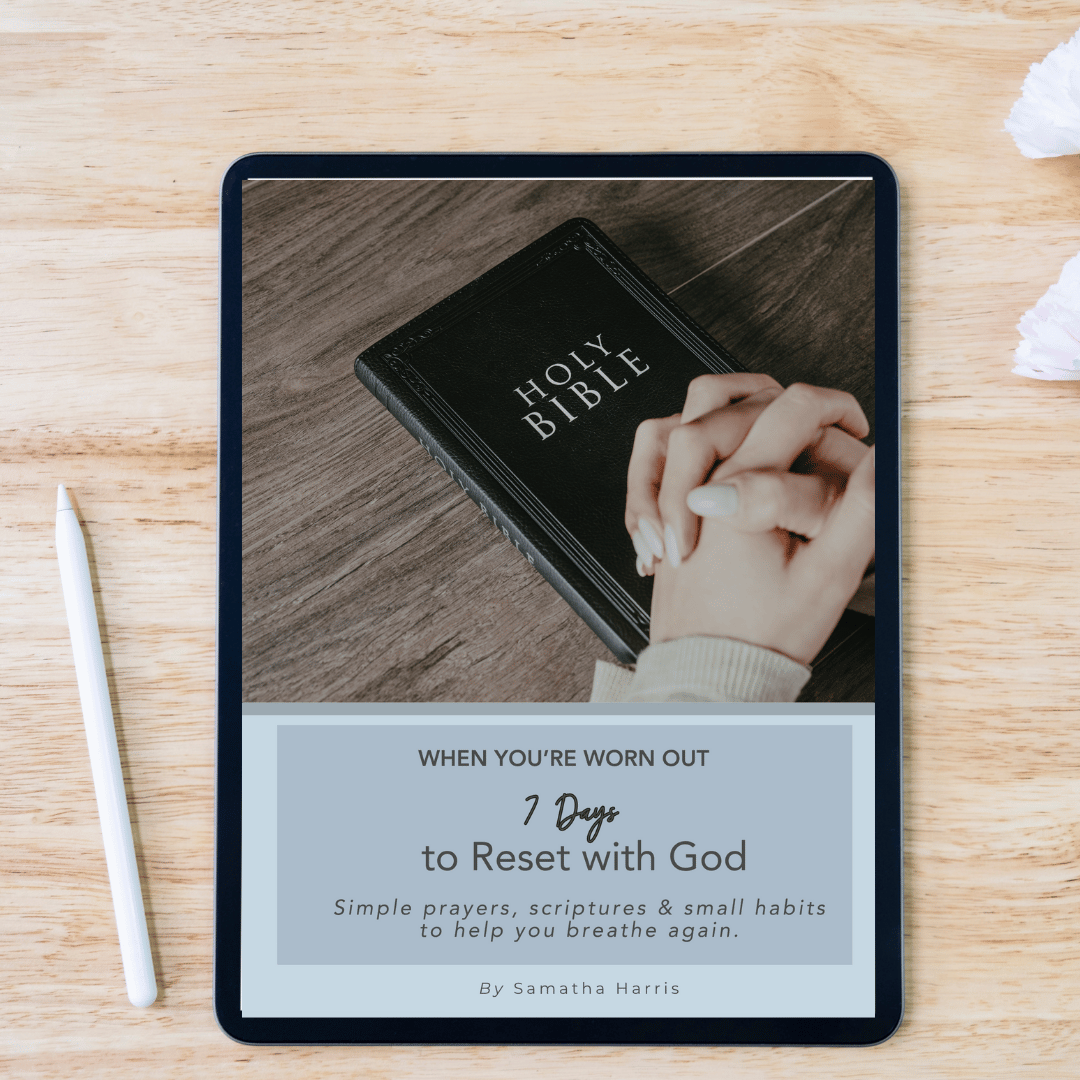
✨ What You’ll Get Inside:
✅ 7 short prayers to help you reconnect with God
✅ Daily Scriptures to guide and ground you
✅ Simple habits to restore peace and focus
✅ Journal prompts for clarity and spiritual reset
✅ A 5-minute rhythm you can actually stick to
💛 Perfect for the woman who feels spiritually tired and needs a gentle reset.
🎁 Download Your Free 7-Day Reset with God
Take your first step toward peace, purpose, and a faith life that feels life-giving again.
LATEST FROM THE BLOG